

About Us

History
Sanatana Dharma (Eternal Dharma) embodies a timeless ethical and metaphysical framework, distinct from sectarian religion. It aims for human flourishing and liberation through the four Puruṣārthas; Dharma (righteous living), Artha (material well-being), Kāma (desire and aesthetic fulfillment), and Mokṣa (spiritual liberation). Mokṣa is achieved by dispelling Avidyā or Māyā, the cognitive veil, through Jñāna, revealing the ever-present Atman, non-different from Brahman.
The ancient Sanatana texts provide a rich foundation for spiritual growth, offering guidance on scripture, meditation, and ethical discipline. These practices were designed to facilitate transformation within the Prakṛti–Puruṣa dynamics. Over time, later commentaries obscured this distinction, and non-Sanatana practices infiltrated daily life. Sri Shankara Bhagavatpada revitalized Sanatana Dharma, emphasizing the Mahāvākyas—Prajnānam brahma, Aham brahmāsmi, Tattvamasi, and Ayam ātmā brahma—which encapsulate the non-dual insight underlying the tradition.
These Mahāvākyas offer a perennial vision, transcending dogma, and continue to inspire yogic practice and ethical living across cultures. However, in recent times, Sanatana practices have become diluted. To reestablish these timeless principles, “Yoga-Samskruthi,” a Vedic Foundation and Religious University, was founded to serve a global audience. The name “Yoga-Samskruthi” reflects our mission, with “Yoga” signifying unification and “Samskrithi” meaning culture, representing the unification of cultures across eras.
Vision Statement
Inspired by the profound wisdom of Sri Adi Shankara’s four Mahāvākyas, “Yoga-Samskruthi” envisions a world where all beings recognize their true nature as one with the Absolute, transcending the limitations of ego, creed, and division. We aspire to a global awakening where the unity of Ātman and Brahman is realized, and consciousness shines as the universal foundation. In this world, humanity flourishes in an era of peace, compassion, and spiritual freedom, where individuals live in harmony with themselves, each other, and the universe.


Mission Statement
Objectives
“Yoga-Samskruthi” is guided by five core principles (Pancha Siddanta) aligned with the five elements (Pancha Tatwa).
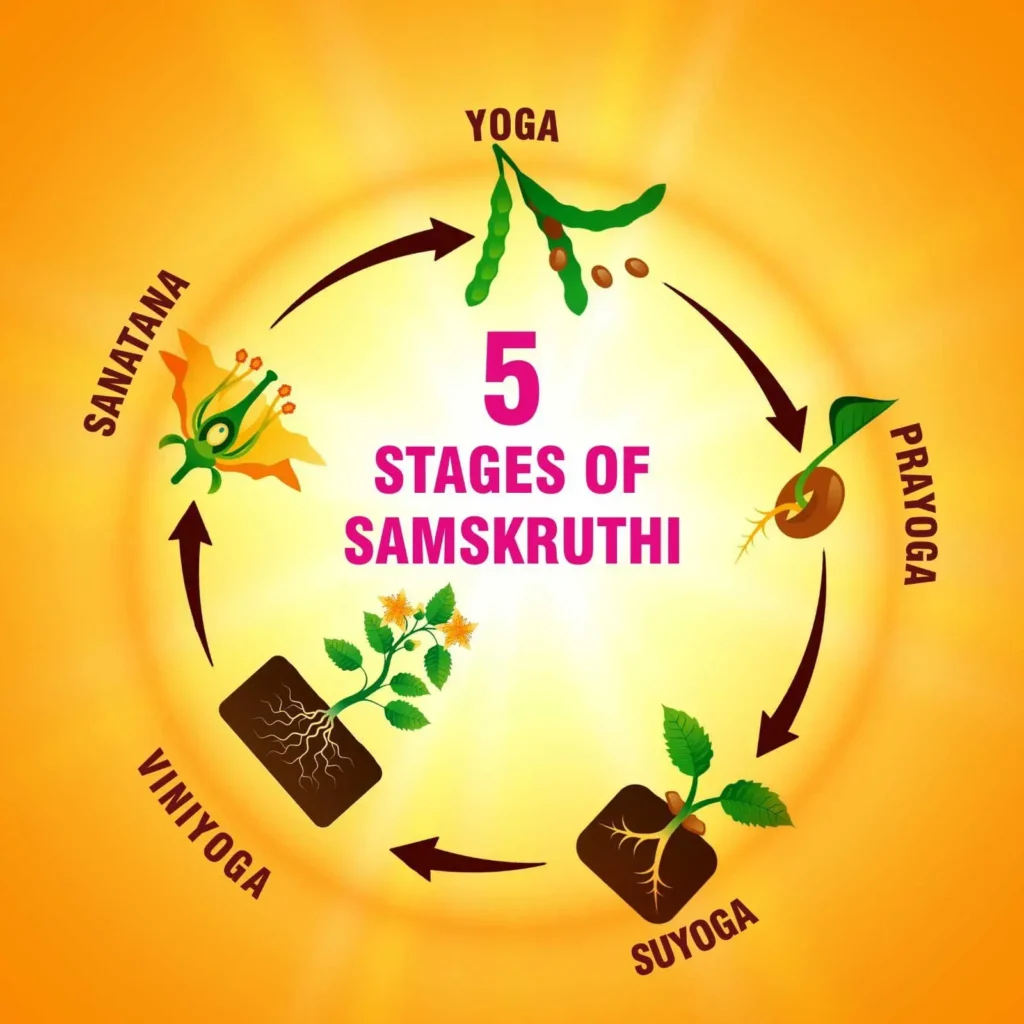
These principles are:
Aakasha Tatwa (Knowledge Union):
“Yoga” signifies the union of the knowledge seeker (student) and the knowledge giver (Guru), forming “Yoga Samskruthi” – a synthesis of all-encompassing knowledge.
Vayu Tatwa (Applied Knowledge)
“Prayoga Samskruthi” applies this knowledge practically, enriching the seeker with true understanding and empowering them to grow.
Agni Tatwa (Transformation)
“Suyoga Samskruthi” transforms the seeker into an energy force, ready to contribute positively, symbolizing the fire element’s transformative power.
Jala Tatwa (Knowledge Dissemination)
“Viniyoga Samskuthi” represents the distribution system, where the seeker evolves into a knowledge giver (Guru), spreading wisdom globally, like the flowing nature of water.
Bhu Tatwa (Revival of Sanatana Samskruthi)
Upon mastering the previous stages, “Sanatana Samskruthi” is revived, fostering a humane and harmonious way of life. Our objective is to re-establish “Sanatana” principles for the welfare of all, providing stability and balance for the divine creation.